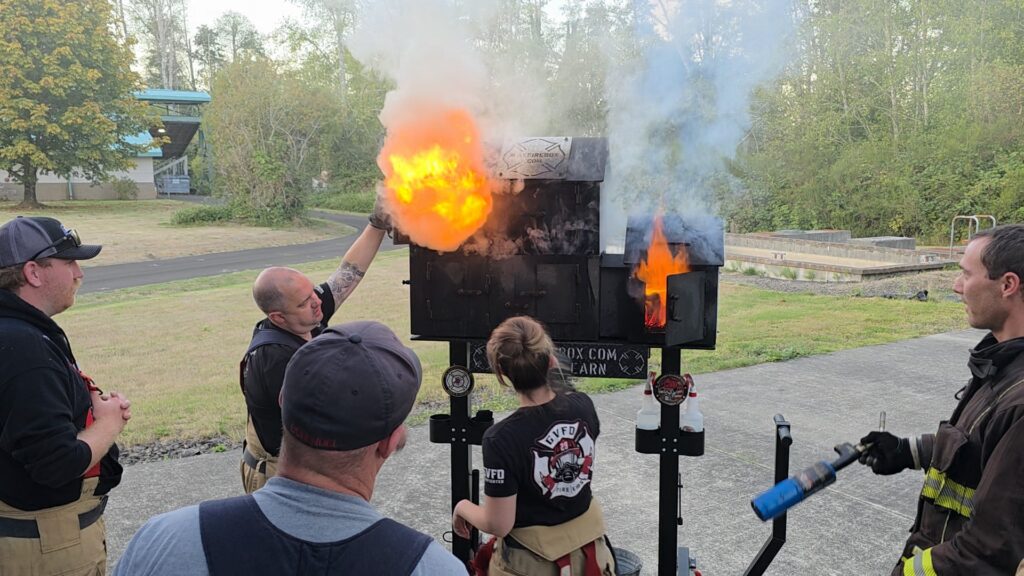
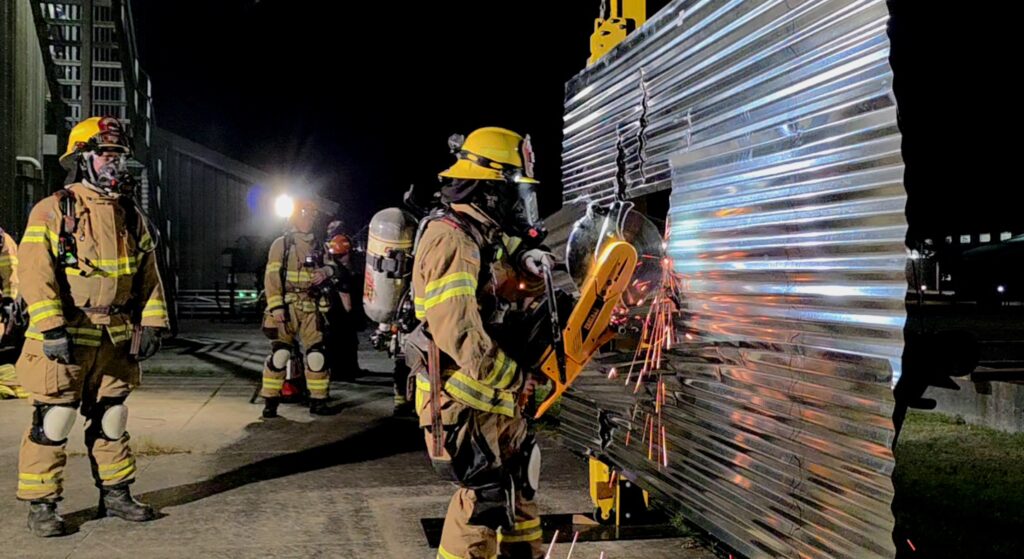
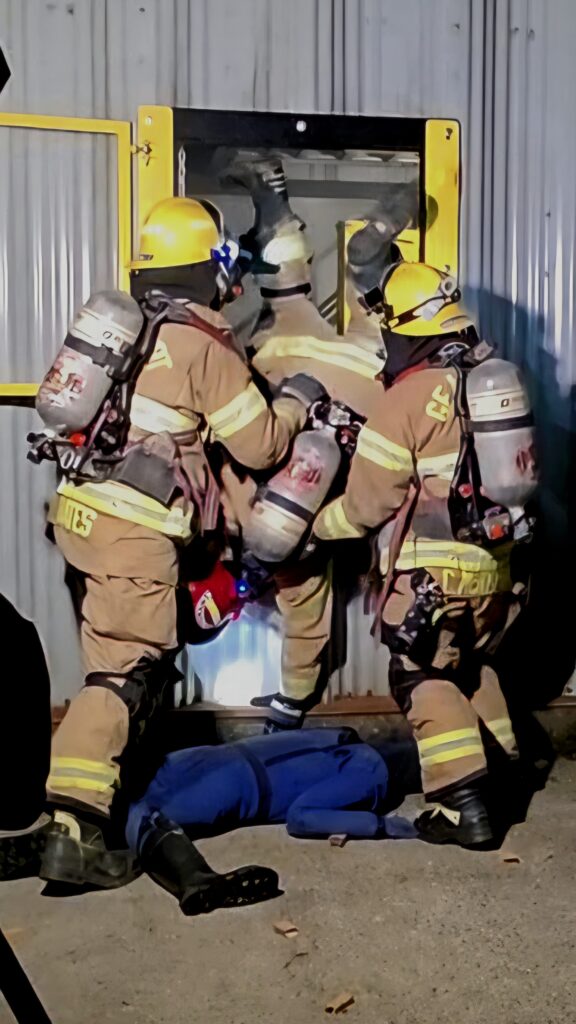
Firefighters from Gearhart Fire Department cut through a simulated garage door, breached a window, forced their way through a door and advanced a charged hose line through a smoke-filled hallway Wednesday night at Clatsop Community College’s MERTS campus.
And that was only the first half of the exercise.
Once firefighters located and extinguished the simulated structure fire, they had to find a life-size rescue dummy and bring the “victim” back through the same obstacles maneuvering the dummy down the hallway, through the breached doorway and out the window.
This was the first time several firefighter training props purchased by CCC’s Fire Science Program with support from the Roundhouse Foundation were incorporated in a training scenario. The investment expands the hands-on training available not only to CCC Fire Science students, but also to fire departments throughout the region that use the College’s facilities for ongoing training.
Tony Como, CCC Fire Science Instructional Assistant and operator of the College’s fire burn building, designed the evening’s obstacle course to put the new equipment to work as part of a realistic, multi-stage emergency scenario.
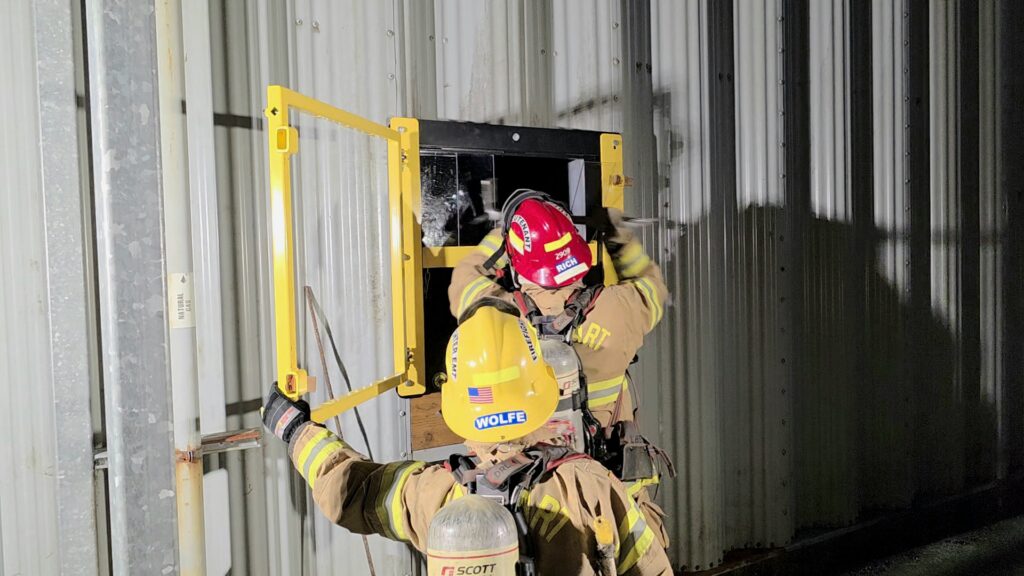
The equipment includes a garage door prop that allows firefighters to practice cutting through garage-style barriers; a window prop that simulates breaking glass and window supports while allowing the components to be reset for repeated training; and a door and hinge prop that gives firefighters experience maneuvering and getting through barriers they may encounter when trying to enter or exit a structure.
Rather than practicing each skill separately, Como arranged the props so firefighters had to move from one challenge directly into the next while continuing to respond to the larger emergency.
Gearhart Fire Chief Josh Como said that approach brought together numerous skills his firefighters had previously learned and required them to apply those skills as part of one continuous operation.
“The evolution, what we went through from cutting the garage door to breaching the window, to going through the door, it took eight to 12 different skills we’ve taught the crew, and then combined it together into one,” Como said. “They went through and did fire attack, search and rescue, and extricated the victim, and did it all in reverse.”
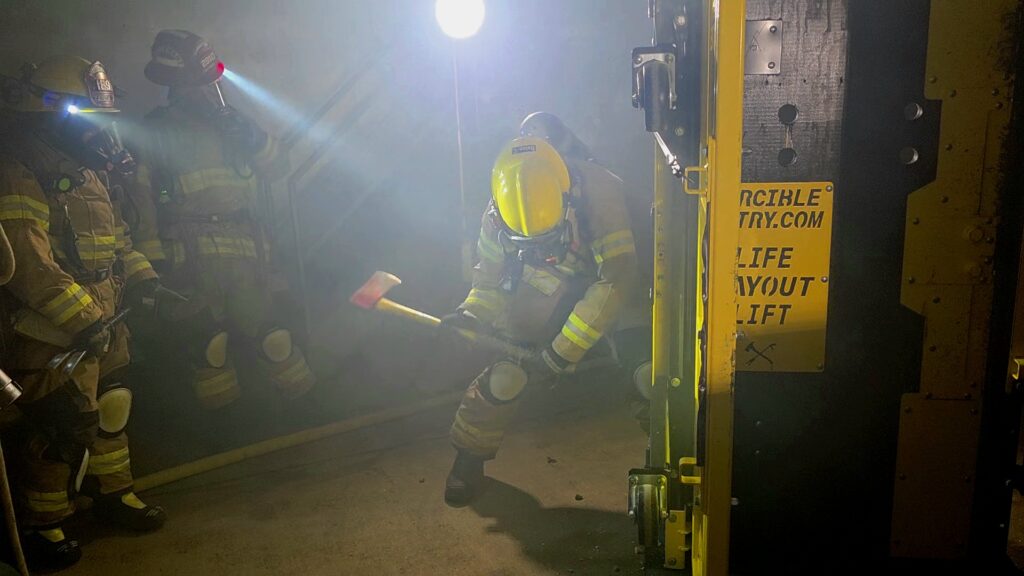
For some members of the Gearhart crew, the training also provided their first opportunity to practice specific techniques, including breaching the window prop and forcing hinges.
“It was great training for the crew. It was something new and fresh,” Como said. “We kind of have the philosophy: if you stop training, you stop moving forward.”
Having this type of equipment permanently available at CCC is especially valuable for local departments. Como said similar specialized training equipment can sometimes be accessed through the Oregon Department of Public Safety Standards and Training, but departments need to schedule it months in advance, and it can be challenging to find a time that works.
“Having this here, right in our back door, that we can come and use it is huge,” Como said.
The Roundhouse Foundation funding also supported the purchase of a MaxFire Box, a model structure that allows firefighters and students to study how fire and smoke move through a building. By changing where a fire begins and opening or closing windows and doors, instructors can demonstrate how ventilation and building conditions affect fire growth, smoke movement and conditions for occupants.
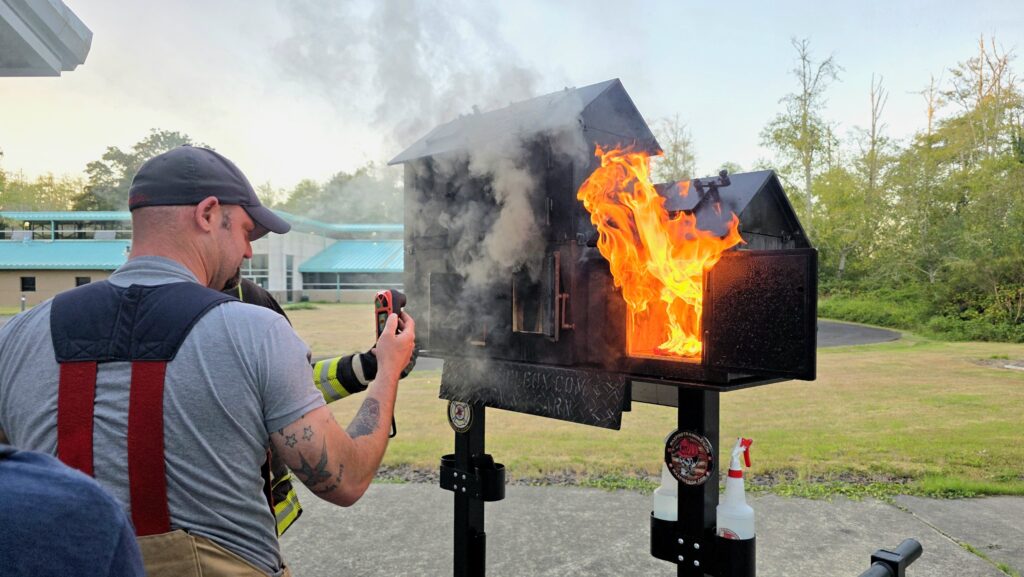
The MaxFire Box provides a way for firefighters to visualize fire behavior and work through different scenarios before encountering similar conditions during live-fire exercises. Crews can discuss how their actions may change conditions inside a structure and evaluate strategies for containing a fire and protecting occupants and firefighters.
The new equipment adds to CCC’s existing fire training resources at the MERTS campus and strengthens the College’s role as a regional training partner. That role is particularly important in Clatsop County, where individual fire departments routinely depend upon one another during larger incidents. Gearhart Fire, for example, is a combination department with two paid positions and approximately 25 to 30 volunteer firefighters. During this recent training at MERTS, Seaside Fire provided coverage for Gearhart while its crew traveled to the campus.
Como explained that this cooperation extends throughout the county. When a significant structure fire occurs, neighboring departments respond to assist while other agencies move into position to provide coverage. Departments also routinely train together so firefighters are prepared to work as a coordinated team when an emergency occurs.
“We operate as one Clatsop County,” Como said, noting that local firefighters also deploy together as a Clatsop County task force to wildland fires throughout Oregon and into California.
That makes opportunities to train locally particularly valuable. CCC’s Fire Science facilities allow area departments to practice skills together and provide access to live-fire training needed to maintain firefighter proficiency and meet annual training requirements.
Como said Gearhart Fire tries to use the MERTS facilities several times each year when scheduling, staffing and emergency coverage allow. “You can’t put a price on it. It’s invaluable,” Como said of having the training facility available locally.
For CCC, the Roundhouse-funded equipment means Fire Science students and working firefighters can encounter a wider variety of situations in a controlled environment building skills, making mistakes safely, repeating techniques and learning how individual tasks fit together during a complex emergency.
Through investments such as the Roundhouse Foundation funding, CCC continues to expand the training resources available at MERTS and support the firefighters and departments that protect communities throughout the region.