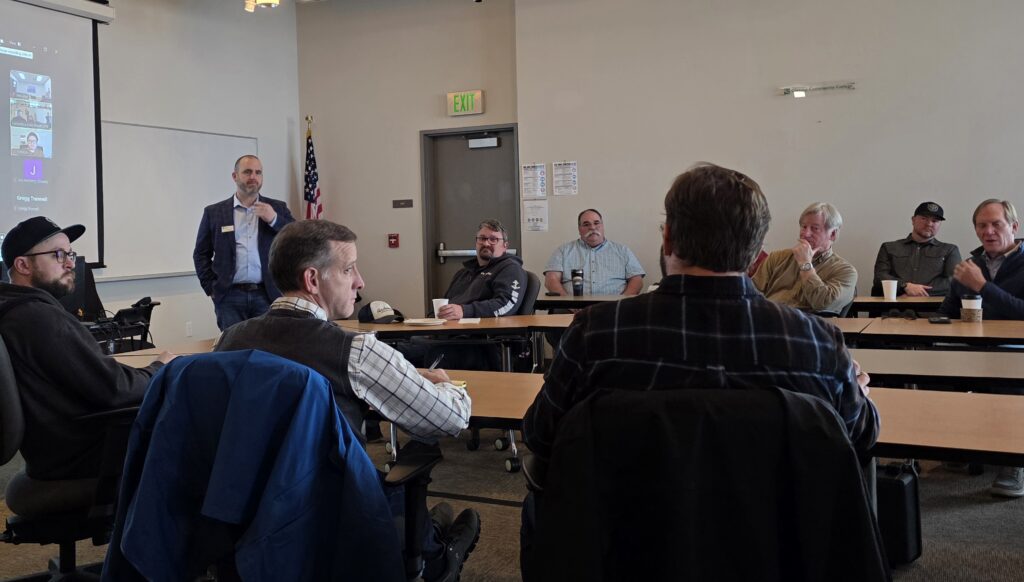
Clatsop Community College President Jarrod Hogue convened maritime industry leaders from across the region on Friday, December 12th, 2025, for a Maritime Summit focused on shaping the future of maritime training in Oregon and ensuring the college’s programs align directly with industry needs.
The summit brought together maritime organizations and area companies to discuss workforce challenges and the potential development of a state-of-the-art maritime simulator at CCC. The proposed simulator would support both student education and ongoing professional training needs, strengthening the regional maritime workforce and improving safety and operational readiness across the industry.
“Our goal is to listen first,” said Hogue. “As we pursue a state match grant of up to $8 million, it’s critical that what we build truly serves industry needs. This summit was about making sure our vision aligns with the expectations of the professionals who will use this training and hire our graduates.”
Industry participants emphasized a statewide need for maritime simulation training. Oregon currently lacks a maritime simulator and must rely on going out of state for simulation training, assessment, and certification. Participants noted that simulation allows mariners to safely practice complex maneuvers and emergency scenarios while reducing real-world risk and liability.
Discussions focused types of simulations needed to support the Pacific Northwest region including a full-mission bridge simulator, tug simulators, ship handling, docking and undocking, collision avoidance, and river navigation scenarios. Industry representatives stressed the importance of high visual realism, custom vessel models, and geographic accuracy for the Columbia River and coastal waterways, as well as the ability to expand the simulator to meet future technologies and industry demands.
The summit also highlighted CCC’s unique role in maritime education. The college is Oregon’s designated maritime training provider, offering approved training, certification, and licensing. Its MERTS campus features a three-story training structure that simulates a ship environment, complete with an engine room and non-toxic smoke for marine fire emergency response training, as well as a 50-foot training vessel used by students. However, the primary maritime facility, built in 1996, has areas where siding and roofing are failing and is due for modernization.
Up to $8 million in matching funds is available from the state and allocated to make improvements to the Maritime Sciences building and program. If matched, CCC is eligible for the state capital funding, which needs to be secured within the next year.
Key next steps identified at the summit include forming an industry steering committee, scheduling regular check-ins with stakeholders, engaging potential donors and industry partners, and expanding outreach to high schools and the broader community to raise awareness of maritime careers. Participants noted that maritime careers are often high-paying, stable, and accessible without a traditional four-year degree, yet remain under-recognized by students and guidance counselors.
“This project is about partnership,” Hogue said. “By working side by side with industry, we can build a training resource that supports workforce development and ensures that the maritime sector in our region continues to thrive.”
Clatsop Community College will continue industry engagement as it refines the project scope and advances funding efforts for the maritime simulator initiative.